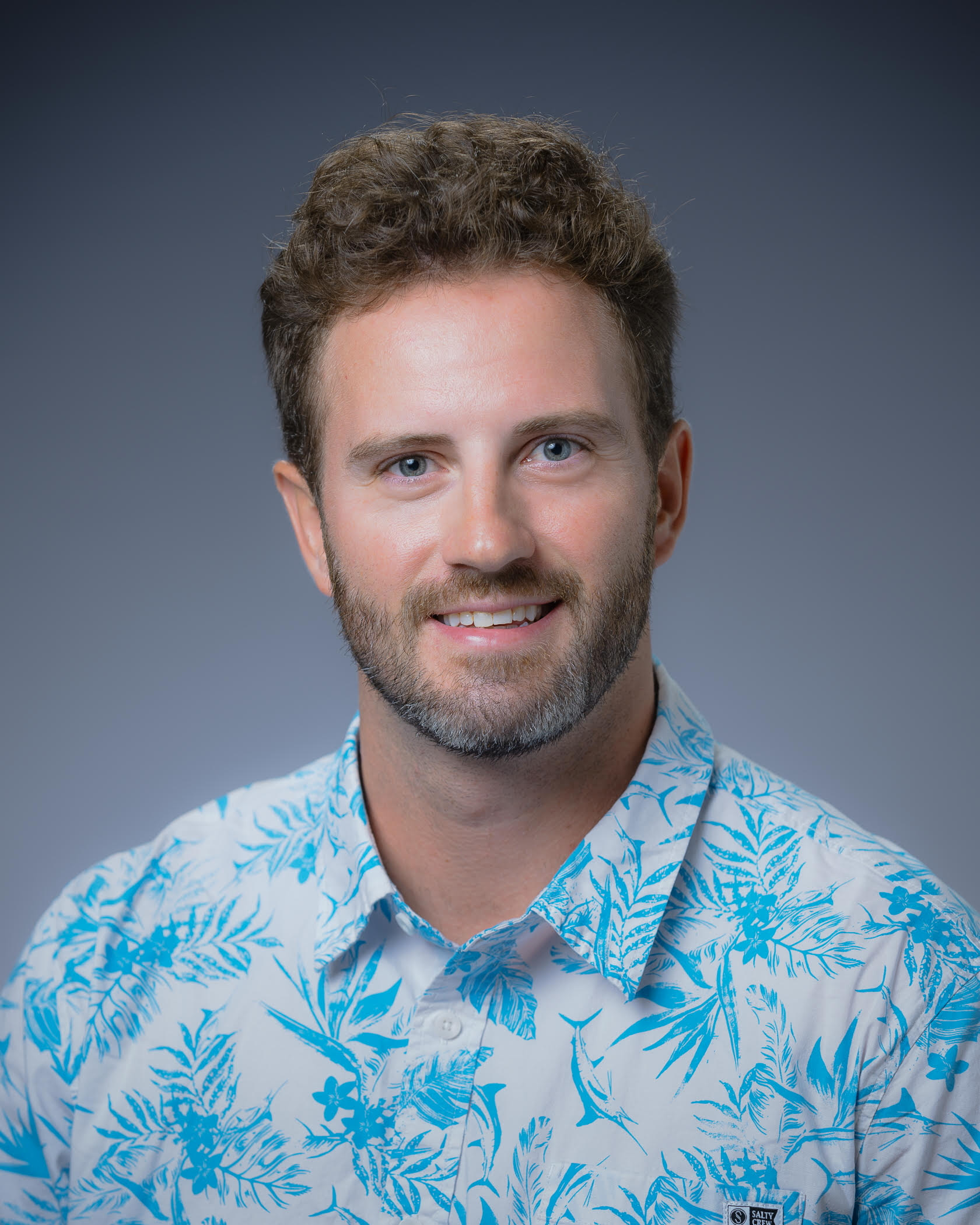
KEETON KRAUSE, M.S.
Keeton currently serves as the Laboratory Manager for the Maunakea research lab on the main campus at the University of Hawaii at Manoa. He oversees day to day operations of the lab, and acts a liaison between the Principle Investigator (PI) Dr. Alika Maunakea and his graduate and undergraduate students. He is involved with a wide range of responsibilities including: scheduling, planning studies and events, supply procurement, inventory tracking, budgeting, administrative processes, graduate student development, community outreach, laboratory compliance, benchwork and wet lab experiments, Standard Operating Procedure (SOP) development, and maintenance of scientific instruments. Keeton is a highly motivated and optimistic person that believes our best work is done in a collaborative and supporting environment that allows us to realize our full potential as individuals and scientists.
Keeton moved to Hawaii from the mainland in 2016 to complete his Masters in Biomedical Sciences at University of Hawaii at Manoa (UHM) at the John A. Burns School of Medicine (JABSOM) within the Department of Tropical Medicine, Medical Microbiology, and Pharmacology. His research focus was flaviviral pathogenesis, where he worked to develop a novel and accurate animal model to study Zika virus infection in pregnant guinea pigs. His lab techniques ranged from animal models, cell culture, and a variety of protein and molecular assays including qRT-PCR and Luminex. During his time as a masters student, he was able to author two first author publications, as well as two co-author publications in peer reviewed scientific journals.
Following his masters program, Keeton rejoined the Department of Tropical Medicine at JABSOM where he served as the Program Coordinator for the Minority Health International Research Training (MHIRT) Program. As part of his role, Keeton oversaw all the day to day activities regarding the program while he worked with multiple Principle Investigators (PIs) abroad to ensure success on all nine of his students research projects. Keeton worked directly with his local UH PI to develop and manage the entire program budget, supply inventory, schedules, communication, and classroom/laboratory training for the program students. Students were sent to four sites abroad with two in India and two in Thailand, where they would complete both a laboratory research project and cultural project about their respective countries. To finish off the program, students would return to Hawaii and share their research and cultural experiences with family, friends, researchers, and students during an end of the year banquet.
Keeton then served as a Microbiologist for the Hawaii State Department of Health in the State Laboratory Division, within the Biological Response section beginning in November of 2019. Once the Coronavirus Pandemic made its way into Hawaii, Keeton was among the first handful of people within the state of Hawaii to perform clinical diagnostic testing for Coronavirus infections. He also completed routine arboviral testing for the state of Hawaii and United States Affiliated Pacific Island (USAPI) territories such as Guam and American Samoa. During that time he routinely maintained and verified clinical laboratory instruments, while also processing and testing thousands of samples for Coronavirus testing.
Keeton’s next role as a Health IT Analyst placed him on the Federal pandemic response effort, formerly known as Operation Warp Speed, and allowed him to assist the Hawaii State Department of Health, as well as all six USAPI territories with their pandemic response efforts. In this role Keeton regularly analyzed any and all data related to COVID metrics and he created reports and deliverables to be utilized by the jurisdictional and federal level partners to better guide pandemic response efforts. As part of this role, Keeton also learned the Health Level Seven (HL7) coding language where we worked with local Immunization Information Systems (IIS) and Electronic Health Record (EHR) systems to establish a bi-directional data exchange between EHR and IIS to become compliant with CDC standards for their Data Modernization Initiative (DMI).
Shortly after, he then worked as a Health Data Analyst and oversaw project management for a PI in the School of Social Sciences here at UHM where the research focused on substance use related data and evaluation of the Hawaii State Department of Health overdose epidemic response and harm reduction services.